

lower gas consumption and CO₂ emissions
 ptiSyn TCR™
Thermochemical
recuperation
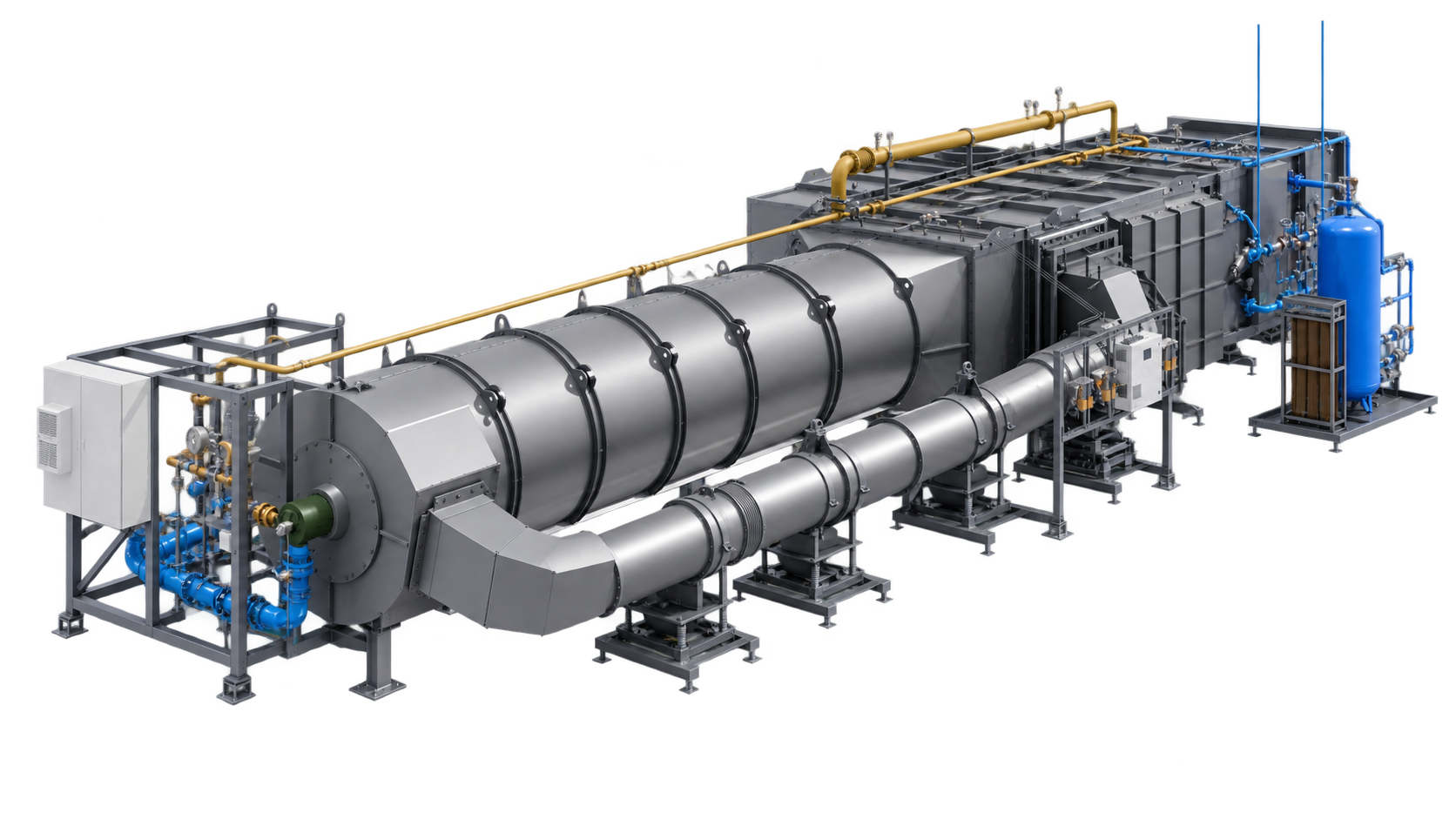
Turn waste heat into lower fuel consumption, reduced emissions and smarter operation – industrial decarbonisation designed to deliver a return on investment.
Key benefits
More than energy savings.
Turn waste heat into lower fuel consumption, reduced emissions and smarter operation — industrial decarbonisation designed to deliver a return on investment.
OptiSyn goes beyond reducing energy consumption — it brings a new approach to industrial thermal processes. By combining state-of-the-art thermochemical recuperation with machine-learning-based control for process optimisation and diagnostics throughout the system's lifetime, it helps reduce consumption, improve operating stability and deliver measurable improvements in production.
indicative investment payback period
suitable for existing systems and various configurations
designed for the future, with the option to use biofuels
Projected benefits include 10–40% lower gas consumption and CO₂ emissions and an indicative payback period of 2–3 years, depending on the process and operating conditions.
How it works
A closed energy loop
in four steps.
01 — Heat recovery
Recovery of high-temperature waste heat from industrial processes.
02 — Conversion to syngas
Heat drives the reforming of natural gas and steam into syngas.
03 — Reuse
Syngas is fed into a dedicated low-NOx burner, reducing the need for primary fuel.
04 — Continuous optimisation
Machine-learning-based control continuously improves operation throughout the system's lifetime.
Thermochemical recuperation
Waste heat is converted into hydrogen-rich fuel.
Very low emissions
Advanced combustion enables cleaner operation.
Intelligent energy management
Optimisation of energy use and operating costs.
Self-learning process intelligence
The system predicts, adapts and optimises operation over time.
Thermal and chemical recuperation
Greater thermal efficiency with TCR.
Conventional approach
In conventional recuperation, waste heat is returned to the process through a heat exchanger to preheat air or material. This reduces the need for primary fuel, but efficiency is limited by the temperature resistance of the materials and the process safety requirements.
 Enlarge diagram ↗
OptiSyn approach
OptiSyn combines thermal and thermochemical recuperation. High-temperature waste heat drives the endothermic reforming of natural gas and steam into hydrogen-rich syngas. Part of the waste heat is therefore stored as chemical energy in the fuel and returned to the process.
 Enlarge diagram ↗
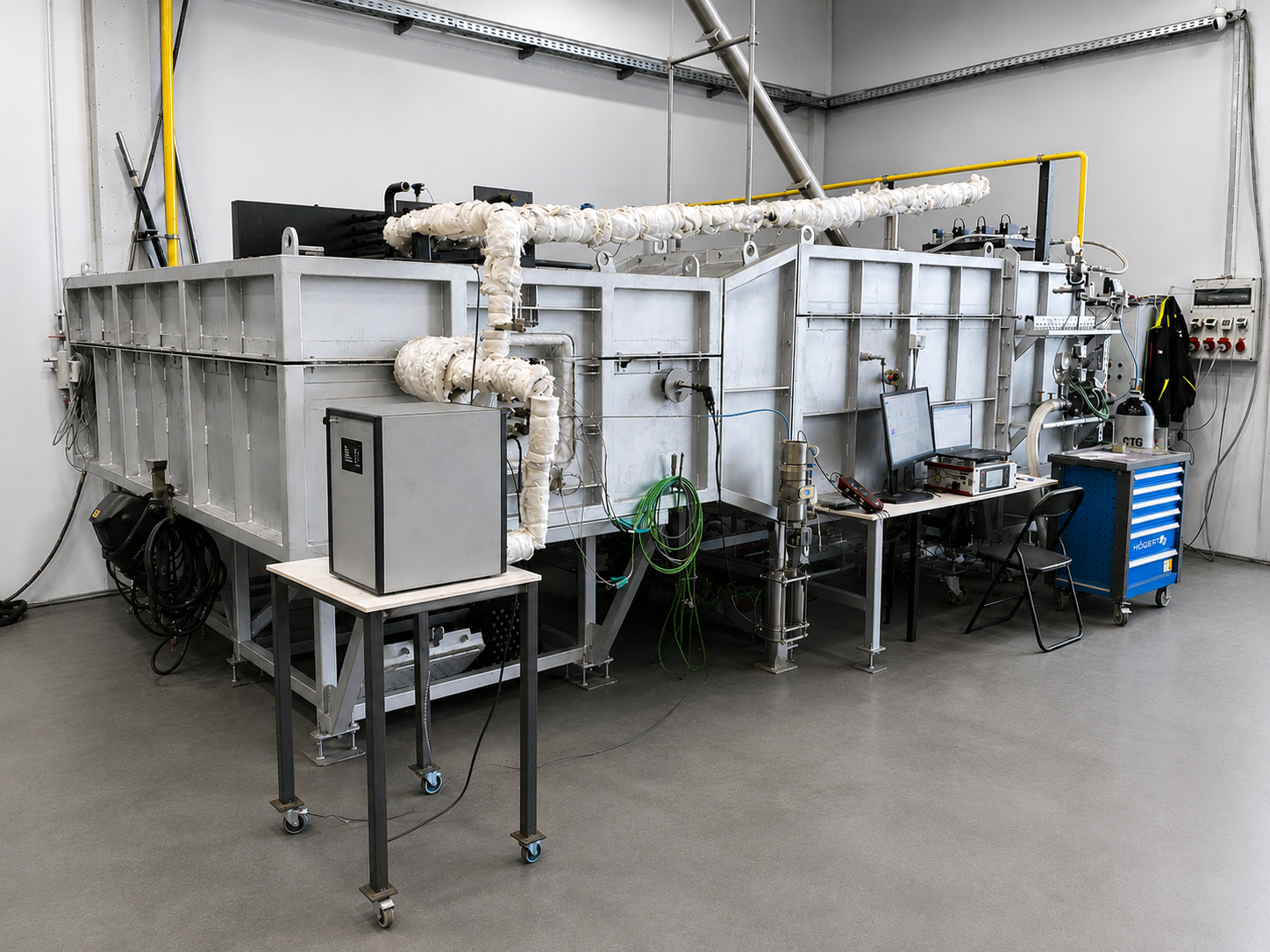
Validated technology
Validated on a prototype.
42%lower gas consumption
42%lower CO₂ emissions
99.55%methane conversion
The test was carried out at a process gas flow rate of 1,400 Nm³/h and a temperature of 860 °C. Measured flue gas values: 10.9% O₂, 1 ppm CO and 24 ppm NOx. The results apply to the stated test conditions.
Industrial integration example
Thermal oxidiser with OptiSyn TCR.
In the thermal oxidiser example shown, OptiSyn reduces the annual energy cost from €900,000 to €600,000 and annual CO₂ emissions from 3,800 to 2,500 tonnes.
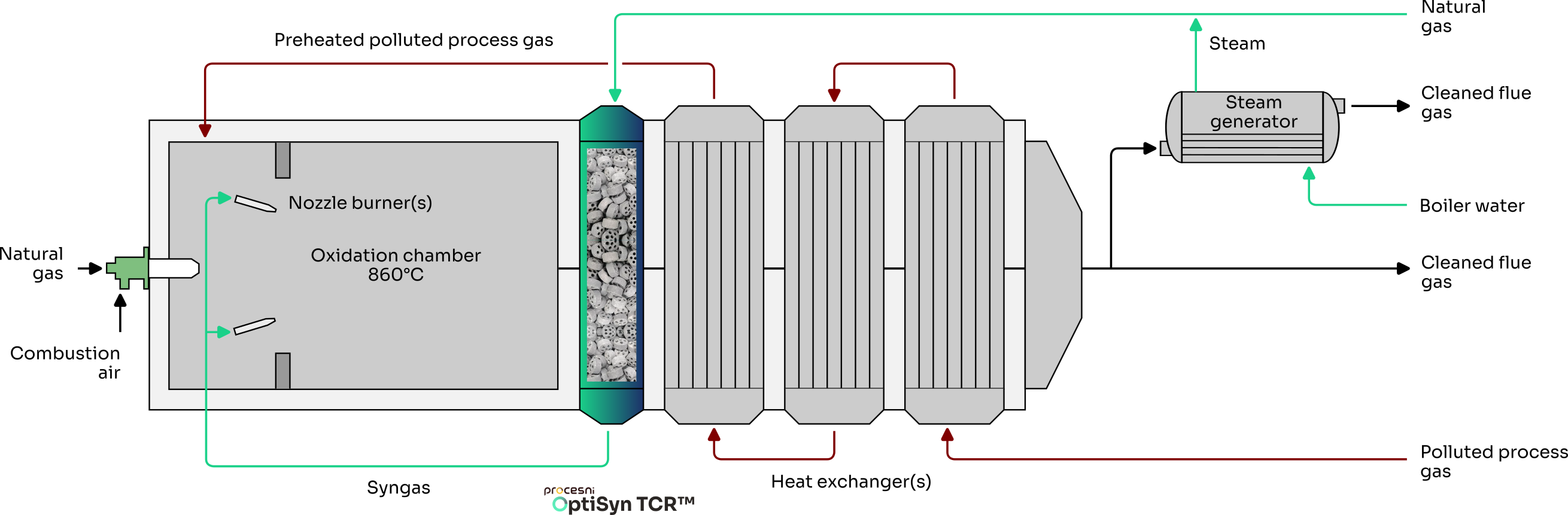 Enlarge diagram ↗
Main components in the diagram: syngas nozzle, oxidation chamber, reformer, heat exchanger, natural gas conditioning and steam generator.
| Metric | Gas only | Electric | OptiSyn TCR |
|---|---|---|---|
| Annual energy cost | €900,000 | €1,200,000 | €600,000 |
| Annual CO₂ emissions | 3,800 t | 2,950 t | 2,500 t |
Example conditions: flow rate of 22,000 Nm³/h, 17% O₂, volatile organic compound (VOC) concentration of 4,000 mg/m³ and 7,920 operating hours per year (330 days). This is an illustrative calculation; actual savings depend on the specific process and operating conditions.
Industrial integration example
Ceramic curing furnace
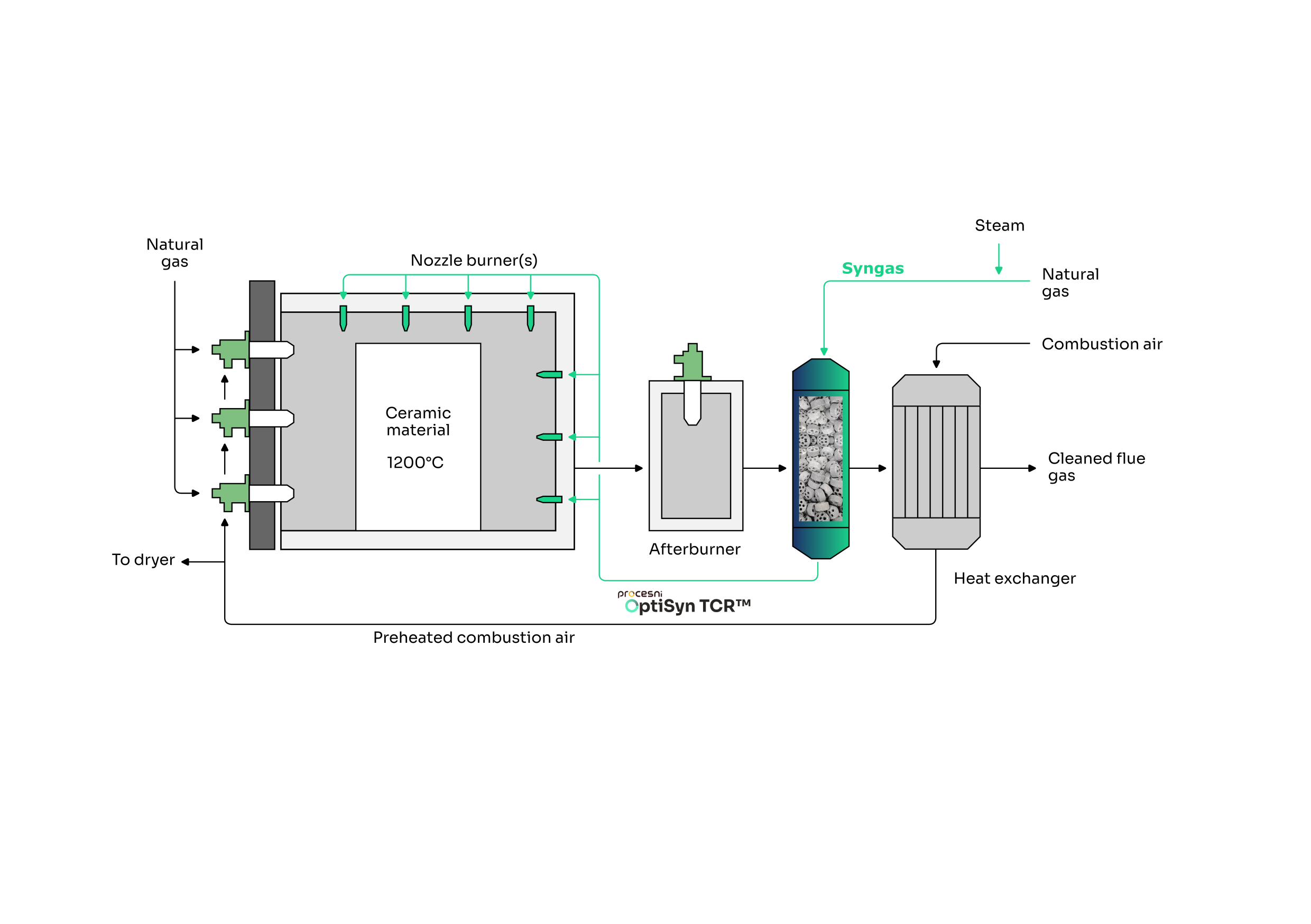 Enlarge diagram ↗
Theoretical reduction in natural gas consumption is 17.3% at a furnace temperature of 1200°C.
The actual industrial saving is expected to be several percentage points lower, depending on heat transfer efficiency, methane conversion and operating conditions.
Consequently, less waste heat may be available for syngas production, even at a higher flue-gas temperature
Industrial integration example
Walking beam furnace
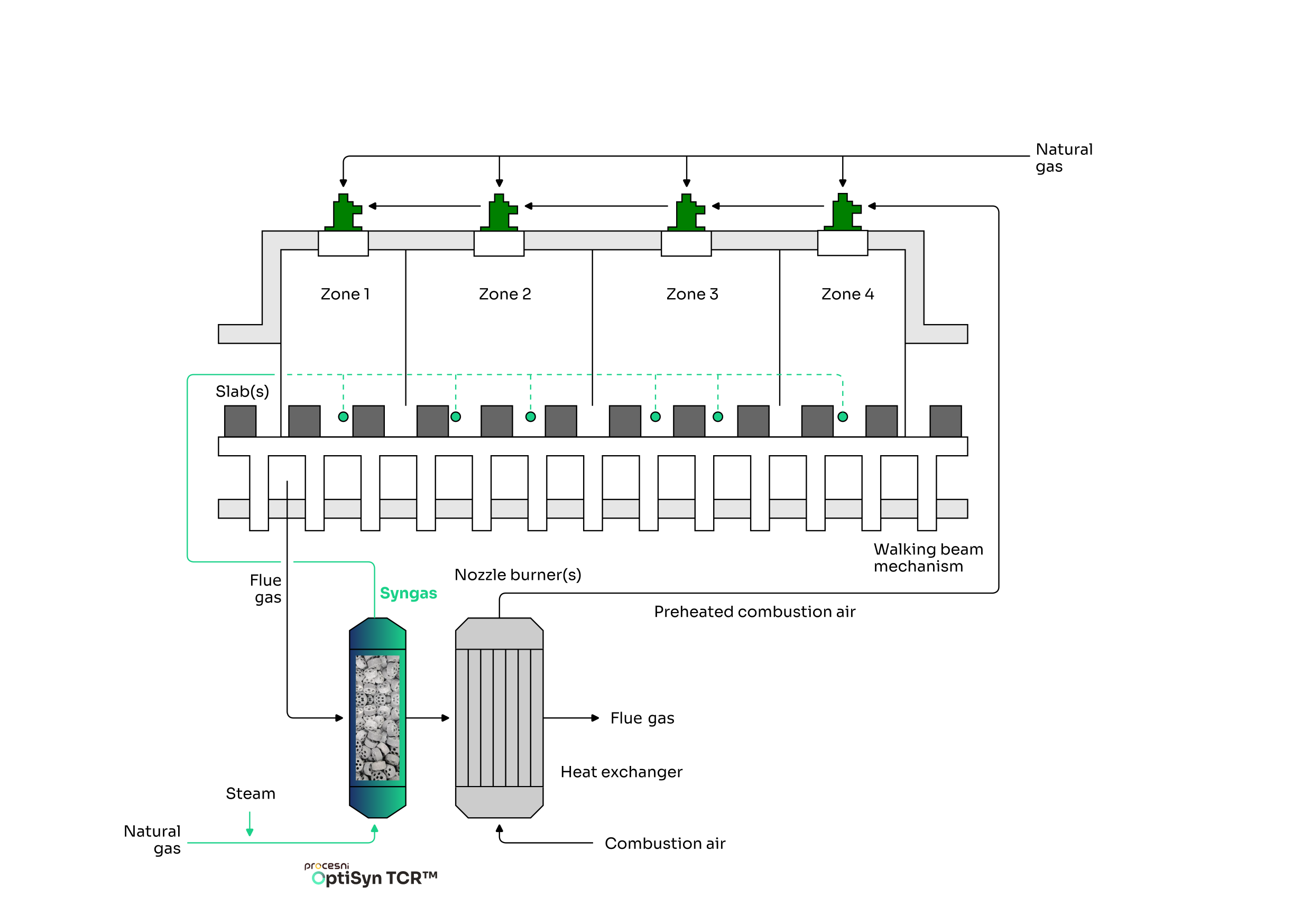 Enlarge diagram ↗
Theoretical natural gas savings
- 13,0% at 1070°C furnace temperature
- 17,3% at 1200°C furnace temperature
- 19,7% at 1350°C furnace temperature